


If you're over 60 and you've quietly concluded that skincare simply doesn't work for you anymore — this article was written for you. Because you're right. It doesn't. And the reason has nothing to do with you.
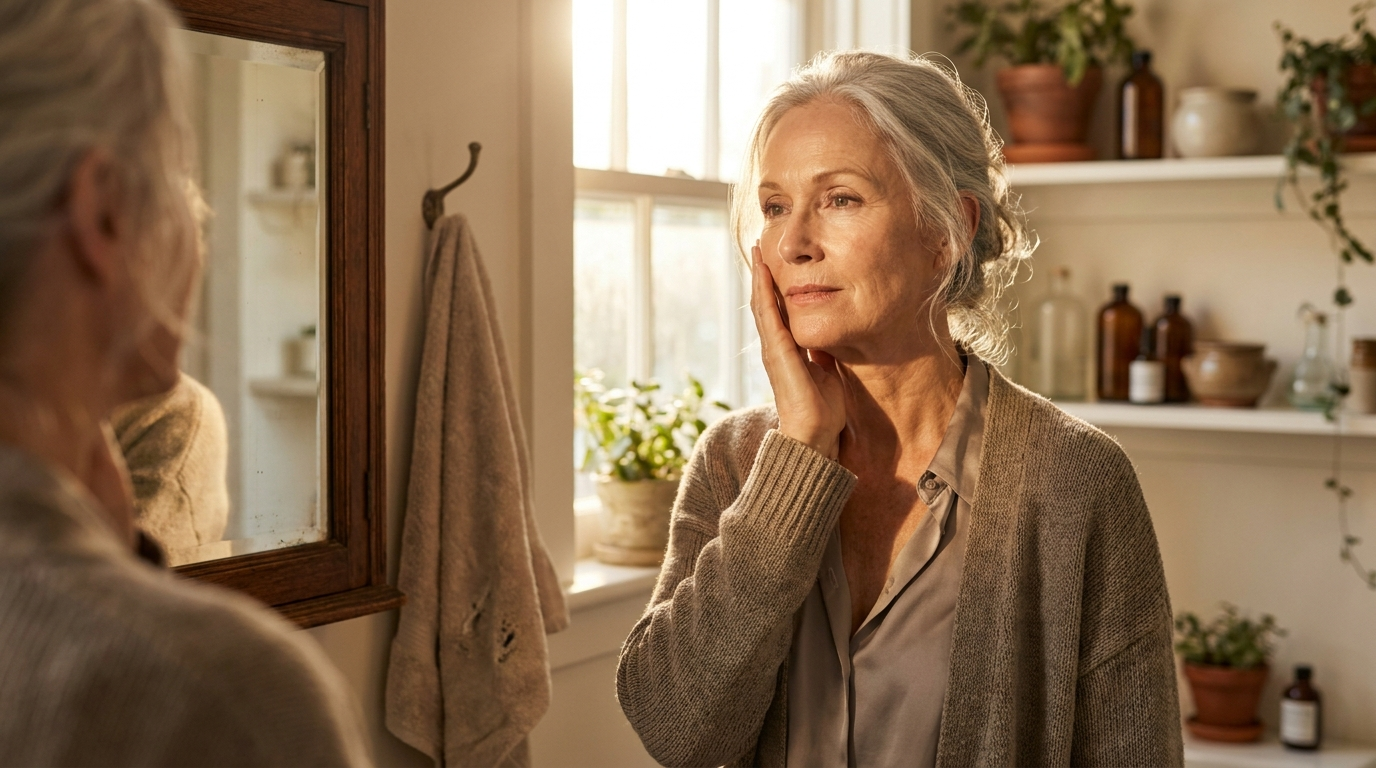
There's a particular morning most women remember.
You catch your reflection — in the bathroom mirror, a shop window, the front camera of your phone — and for a strange half-second, you don't recognize the woman looking back. The deep lines around her mouth. The softened jawline. The crepey skin along her neck. The tired eyes that don't match how awake you feel.
And you think: when did this happen?
Because it didn't feel gradual. For many women, it feels like it happened in a season. One year the mirror was familiar. The next, it belonged to someone older.
So you did what any sensible woman does. You fought back. The serums in the heavy glass jars. The vitamin C. The retinol everyone raves about. The department-store creams with the beautiful packaging and the confident promises.
And one by one, every single product let you down.
If that story sounds familiar, keep reading. Because what follows is the explanation almost nobody gives women over 60 — the real reason nothing has worked, why it was never your fault, and what your skin has actually been asking for all along.
The Uncomfortable Truth About The Skincare Aisle
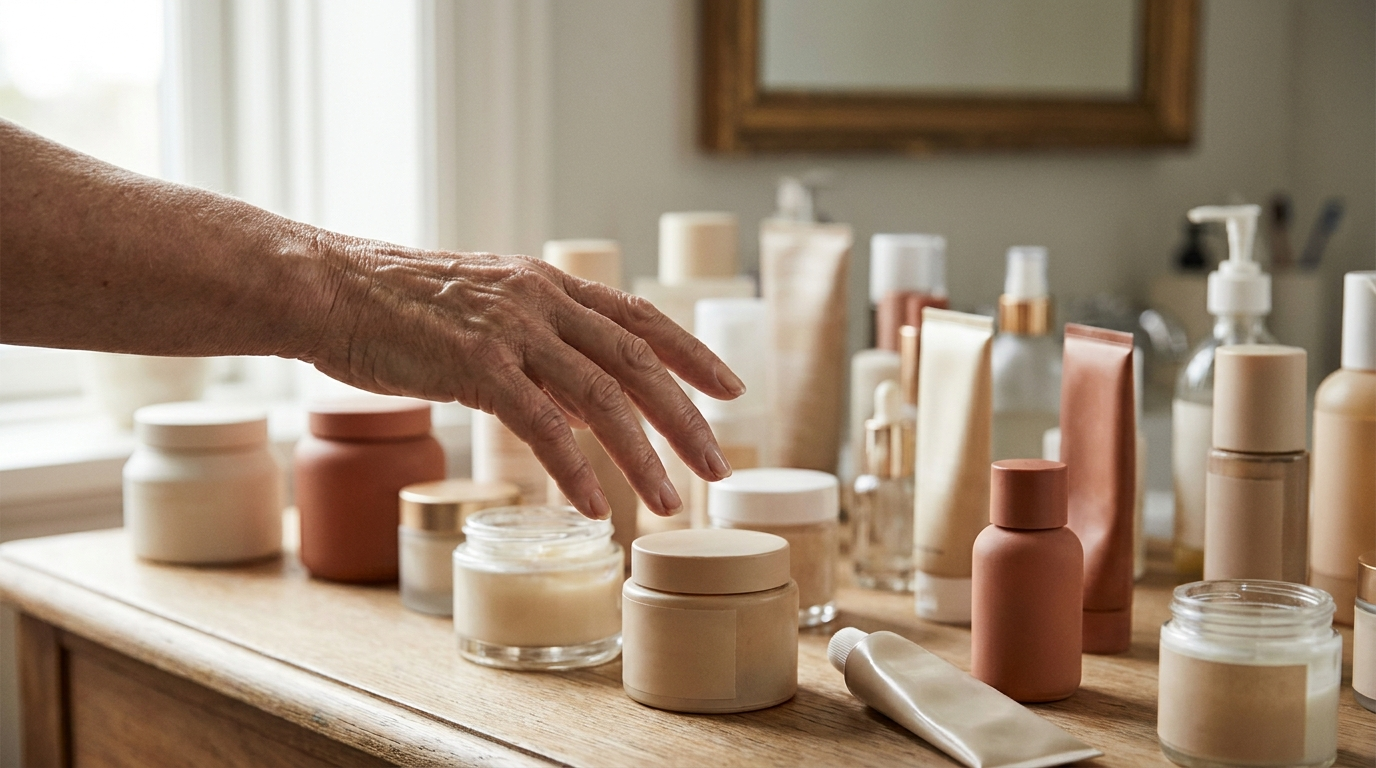
Here is the fact the beauty industry rarely says out loud:
The overwhelming majority of skincare products on the market are formulated for women in their 30s and 40s.
It isn't a conspiracy so much as simple economics. Women in their 30s and 40s are the largest, most profitable skincare market in the world. So that's the skin the formulas are designed for, tested on, and optimized around: young skin that is still firm, still resilient, and — this is the crucial part — still actively repairing itself.
Those products are built to maintain something that's already working. They give young skin a little extra hydration, a little extra protection, a gentle nudge — and young skin, with its healthy repair systems, does the rest.
Then those same formulas are put in prettier jars, given the word "anti-aging," and sold to women over 60.
And on skin over 60, they fail. Not sometimes. Almost always. Here's why.
What Actually Happens To Skin After Menopause
Think of your skin like a house.
The smooth surface you see — the part every cream is rubbed onto — is the paint. But what keeps the house standing, what keeps the walls firm and the lines of the roof straight, is the frame underneath: a dense scaffolding of collagen and elastin that holds your face up from the inside.
For most of your life, your body maintained that frame around the clock. Old beams came down, fresh ones went up. The signal driving that constant rebuilding was, in large part, estrogen.
Then menopause arrives — and the signal goes quiet.
Research on post-menopausal skin shows that collagen production drops sharply once estrogen declines, with a significant share of the skin's collagen lost in just the first several years after menopause. The scaffolding thins. The frame weakens. And the house begins to settle.
That settling is what you see in the mirror:
- Deep lines around the mouth and eyes that seem to carve in overnight
- A softening jawline as the structure beneath it gives way
- Crepey skin on the neck and chest, where the frame was thinnest to begin with
- A tired, dull look — even when you're perfectly well-rested
Notice something important: none of these changes begin at the surface. They all begin in the structure underneath — in the frame, not the paint.
Why Your Creams Never Stood A Chance
Now the failure of every product you've tried starts to make sense.
Problem one: they can't reach the problem. A cream formulated to sit on the surface of young, self-repairing skin does exactly that on your skin too — it sits on the surface. But your problem isn't on the surface anymore. Applying surface creams to post-menopausal skin is like repainting a wall while the frame behind it keeps coming down. The paint may look nice for an afternoon. The house keeps settling.
Problem two: many of them are too harsh. Formulas built for resilient 30-year-old skin often use concentrations that mature, thinner, more delicate skin simply can't tolerate. If you've ever had a product sting, burn, flake, or leave you red for days — that wasn't a sign your skin is "too far gone." It was a sign you were handed something built for a different woman's face.
Problem three: they were never designed to rebuild anything. Maintenance formulas assume the skin's own repair crew is still on the job. After menopause, that crew has largely gone quiet. A product that only moisturizes and protects — without addressing the structure underneath — is managing a symptom while the cause continues.
So let's say the important part plainly: if you've spent years — and hundreds or thousands of dollars — on products that did nothing, you were never the failure. You were using tools built for someone else's skin, on a problem those tools were never designed to reach. It was never your fault.
What Skin Over 60 Actually Needs
Once you understand the real cause, the requirements become clear. Skin after menopause doesn't need more of what failed. It needs something built for a fundamentally different job — a formula that does three things at once:
1. Speak to the skin again. The structural decline began when the skin lost its signal to keep rebuilding. Modern peptide science exists precisely for this: signal peptides are designed to communicate with the skin in a language it recognizes, encouraging it to behave the way it did before the signal went quiet.
2. Support the structure underneath. The visible changes — the deep lines, the sagging, the crepiness — trace back to the weakened frame. Ingredients that support the look of firmness and elasticity need to work with that deeper story, not just decorate the surface. And they must do it gently, at doses mature skin can genuinely tolerate.
3. Flood and hold moisture. Post-menopausal skin doesn't just lose structure — it loses its ability to hold water. That's the tight, papery feeling by mid-morning. Deep hydration, plus a repaired barrier that keeps the moisture in, is what turns a good formula into one your skin can actually live on.
Miss any one of the three, and you're back where you started: another jar on the shelf.
The Formula Finally Built For Skin Over 60
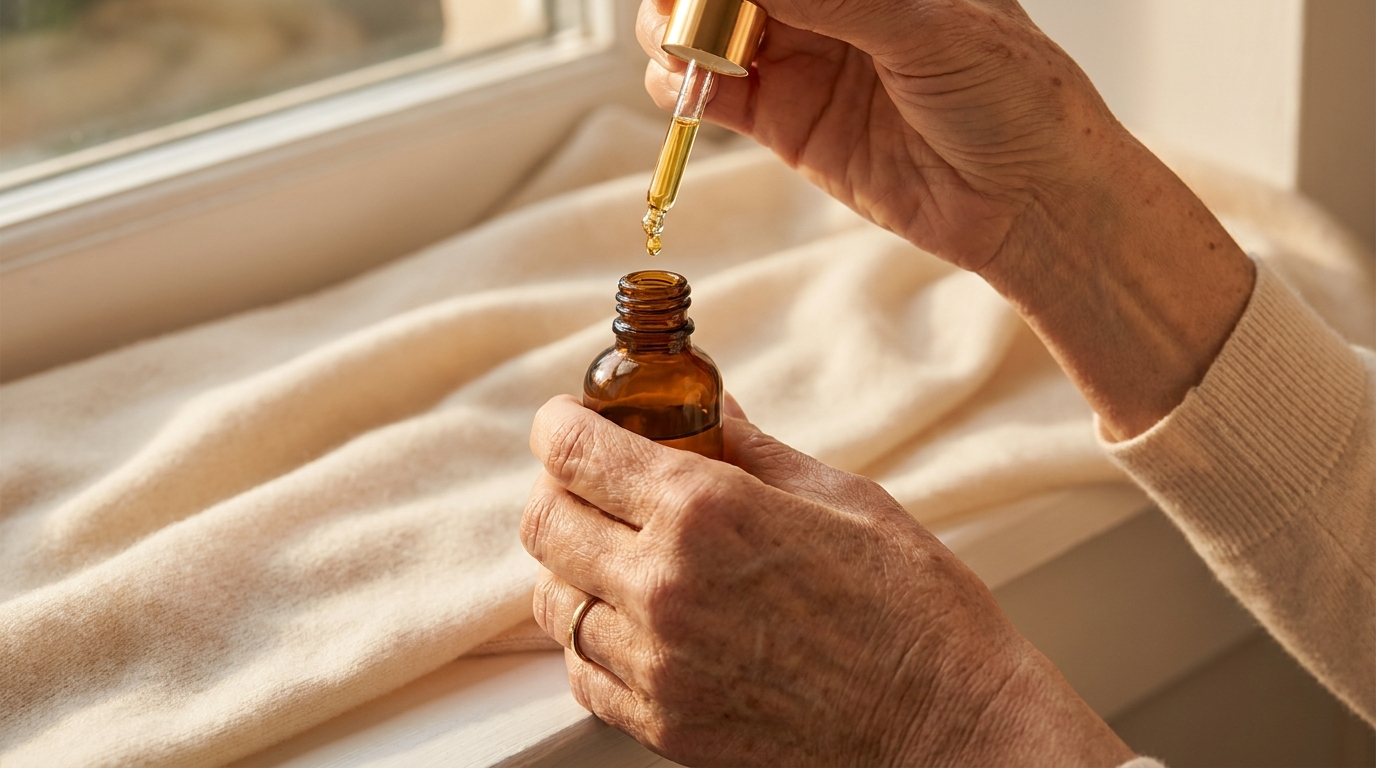
This is exactly the thinking behind Blyme Prime Elixir — a serum formulated from the ground up for post-menopausal skin. Not a young-skin formula relabeled for a new market. Built, ingredient by ingredient, for the skin you actually have now.
Inside one amber bottle:
- A Korean peptide complex — Syn-Ake & Argireline. Two of the most studied signal peptides in modern skincare, often described as topical alternatives to injectables. They're chosen to help relax the look of expression lines and support the appearance of firmer, smoother skin — working with your skin, not against it.
- Gentle, low-dose retinol. Strong enough to help soften the look of deep lines and uneven tone. Deliberately gentle enough for thinner, delicate mature skin — no burning, no angry peeling.
- Tremella & sodium hyaluronate. Tremella, the Korean snow mushroom, holds many times its weight in water; paired with sodium hyaluronate, it pulls deep, lasting hydration into the skin so it feels plump and comfortable instead of tight and papery.
- Centella ("cica") & Ceramide-1. To calm, soothe, and help rebuild the moisture barrier that the menopausal years wear thin — so your skin can finally hold on to everything you give it.
A few drops, morning and night. Thirty seconds. One bottle, in place of the shelf full of jars that never worked.
What Women Typically Notice — Week By Week
Every woman's skin is her own, so results vary — but here is the pattern women most often describe with consistent morning-and-night use:
The first few days: the first surprise is usually what it doesn't do. No stinging, no burning, no irritation. Skin feels calmer, softer, and comfortably hydrated — "fed" is the word that comes up again and again.
Weeks one to three: a brighter, fresher look. Makeup starts gliding on instead of settling into the lines around the mouth. Many women say this is when they start leaning toward the mirror again instead of away from it.
Weeks four to eight: with consistent use, the look of deeper lines may gradually soften, skin along the jaw and neck can appear firmer, and that overall tired, dull cast gives way to a healthier, more rested look.
One honest note: this is not an overnight miracle, because nothing honest is. It's a formula designed around how post-menopausal skin actually behaves — and that kind of change builds week over week, which is exactly why it lasts.
And No — It Is Not Too Late For You

This is the question women ask most, sometimes in a whisper: "But is it too late for me?"
At 62. At 68. At 74. At 81.
No. It is not.
The women who see the most meaningful changes are very often the ones who had given up entirely — because their skin had been running on empty the longest. Skin remains a living organ at every age. Give it what it has actually been missing, at doses it can genuinely use, and it responds. Not the way it did at 30 — the way it can at your age, which is more than most women have been led to expect.
The saddest sentence in skincare is "I just accepted it." Not because acceptance is wrong — but because for so many women, what they accepted was never aging itself. It was the failure of products that were never made for them.
Try It On Your Skin — With A Full Year To Decide
Because women over 60 have been burned by more empty promises than any customer in the beauty industry, Blyme removes the risk entirely:
Every bottle of Prime Elixir is covered by a 365-day money-back guarantee. Use it morning and night. Give your skin the full, honest trial it deserves. And if you don't love what you see in your mirror, you get every penny back — even if the bottle is empty. No forms, no hoops, no hard feelings.
A full year to decide, on a serum that takes thirty seconds a day. After a decade of jars that promised everything and delivered nothing, that's what a formula with nothing to hide looks like.
365-day money-back guarantee · One-time purchase, not a subscription
The Bottom Line
For years, you've been sold maintenance formulas for skin that needed rebuilding, and harsh concentrations for skin that needed gentleness — and then quietly left to believe the failure was yours.
It wasn't. It never was.
Your skin didn't stop responding after 60. The products simply never spoke its language. Blyme Prime Elixir was created to change that — one formula, built for the skin you have now, that gives it the signal, the support, and the moisture it's been silently asking for since the day everything changed.
You've waited long enough to be someone's actual customer, instead of an afterthought in someone else's formula.
Results vary from person to person. This article is for informational purposes and is not medical advice. Statements have not been evaluated by the FDA. This product is not intended to diagnose, treat, cure, or prevent any disease.